

“May I ask a question please?”
A tiny hand is raised.
The teacher smiles at the curious eyes.
The sun peeks at her dimpled dreams.
The pages of the book turn.
The window stretches to the future.
A pathway to untold stories.
This short poem reflects the true power of education. A chance to transform such curious minds into builders of tomorrow. Education has always been a deeply personal topic for most of us. We have all been through it and we have our own view of the “gaps” in the system.
But when we trace the story of education in India through the path of capital, we find a different narrative, one that's now urgent to rewrite. Until a few years ago, education was funded primarily through public money, philanthropic giving, and long-horizon impact capital. The kind of funding that understands systems change takes time. That real learning is not a 10-min delivery model, It’s often a lifelong shift that doesn't show returns in quarters, but in generations.
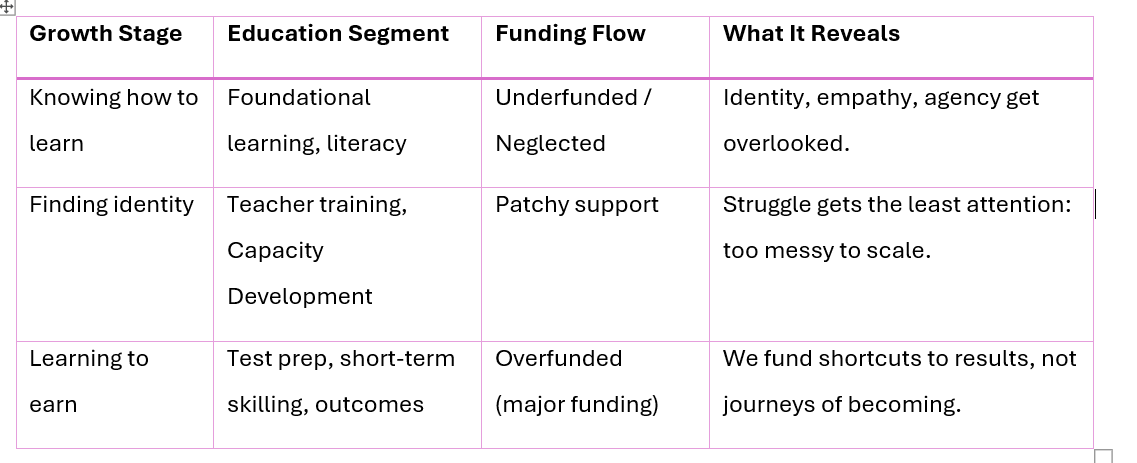
That shifted post-2018, and more radically so during the pandemic when schools closed and screens opened and private capital sought rapid scale into certain areas of EdTech. Test Prep & K-12 EdTech received 80%+ of total funding specially from 2018–2022, the years of blitz funding. But capital remained scarce for foundational learning, teacher dignity, support, or story-based learning despite being central to policy mandates like NIPUN Bharat.
What the data tells us when analyzed from a student’s growth narrative:
Investors funded the ending before the beginning of the learning story. Even after the post COVID funding dip, capital was still searching for the right story. Why? Because money follows narrative or story. And in education, we’ve been telling the wrong story.
Why This Story is Incomplete
This narrative isn’t just flawed. It’s dangerous. When we overfund the ending and ignore the beginning, we build systems that:
- Burn out learners
- Leave out the marginalized
- Miss the point of learning: transformation, not transaction
There are two parts of the narrative that deserve re-entry for those seriously building for sustained Education impact.
1. Foundational Learning
Before we talk about outcomes, we must talk about beginnings. The ability to read a paragraph, to add and subtract, these are not small metrics. They are thresholds. They are what allow a child to step into their own voice.
Despite more children attending schools at the primary level, foundational literacy and numeracy skills (FLN) as defined by World Bank as the ability to read simple text or perform simple addition and subtraction is still far from being at the right grade level of knowledge. In fact, per World Bank’s Learning Poverty Indicator recommends that by age ten, children should be able to read simple text else it leads to a learning poverty.
Pre-pandemic, 50% of children in India were in learning poverty by the age of 10. The gap became worse where digital access was weakest during the pandemic. And unless we address it early, every other investment becomes remediation.
According to multiple education experts and early childhood education companies, foundational learning, and within that, the knowledge of language, is like a leading indicator for learning levels. Whether it is solving word problems in math or understanding concepts of Physics and Chemistry, language remains a key barometer in the indication of how children can understand a subject. If children fall behind this, by the age of ten, it is tough for them post that to improve on their foundational skills.
It requires deep systems thinking, scale across different types of school systems, assessment methods that are easy to integrate with teaching-learning methods.
2. Skilling: with Mastery, not just speed
There is a certain romance to the linear path: school, college, job. But that path is bending now.
In fact, history is full of alternatives that worked better and which shaped mastery, before jobs. Let's return to the majestic city of Florence. Before we marvel at the art and sculpture that live to tell the story even today, let's remember the city as it was at the time of renaissance. In the late fifteenth century, for example, just in this location, there were as many as fifty-four workshops for working on marble and stone artefacts employing many master gold and silversmiths as well as painters.
Leonardo Da Vinci started off as one such apprentice artist to one of the great artists of this time. In fact, in an interesting explanation, an article from Star Tribune explained that the word “masterpiece” that we attribute now to magical works of creativity even today, originated at this time when apprentice artisans had to showcase their skills to the guild. It was like a rite of passage which, if demonstrated successfully, would allow the apprentice to become a master in their own turn and be authorized to train others
In India as well, the earlier established model of education from gurukuls to gharanas for music exemplified this kind of immersive and skill-based training that prepared people for a lifetime in the craft they mastered. Mastery takes time, presence, and repetition. It takes apprenticeship, not speed. And in a country with one of the highest number of people in job seeking age groups globally, we need to imagine newer, deeper routes to work and worth.
The Policy exists. Capital has to follow. Narrative has to lead.
Thankfully, the New Education Policy (NEP 2020) makes space for these shifts. Flexible credit systems. Integrated vocational tracks. Blended learning models. Greater autonomy for learners. But policy alone is not enough. For the shift to happen, capital must change its story too.
And maybe that means asking quieter questions. What if the next breakthrough doesn’t look like a unicorn? What if it grows slower, deeper, and lasts longer? Across some of the work we’re part of, designing growth narratives, building storytelling systems for learning outcomes, creating formats for cross-sector skilling, we’re seeing one thing emerge with clarity:
When capital aligns with narrative and belief, transformation is not just possible. It’s scalable So perhaps the real question is not: Where do we invest next? But: What story do we believe in enough to fund from the very beginning?
If you’re holding this question too, let’s keep talking. Because the right story, told well and built patiently, can help change the lives of more curious learner-builders of today and tomorrow.