
Every major technology shift creates a period where narratives run ahead of numbers. Over time, as the gap starts narrowing, the numbers also begin to reveal something more interesting than the narrative itself: they reveal where value is accumulating. That is what makes this earnings season particularly significant.
For the past two years, the conversation around AI has largely been framed around models, breakthroughs, and capabilities. Earnings are now providing a different lens. They are helping us understand how AI is reorganizing value creation across industries and where economic benefits are beginning to accrue. Viewed through that lens, recent results tell a remarkably coherent story.
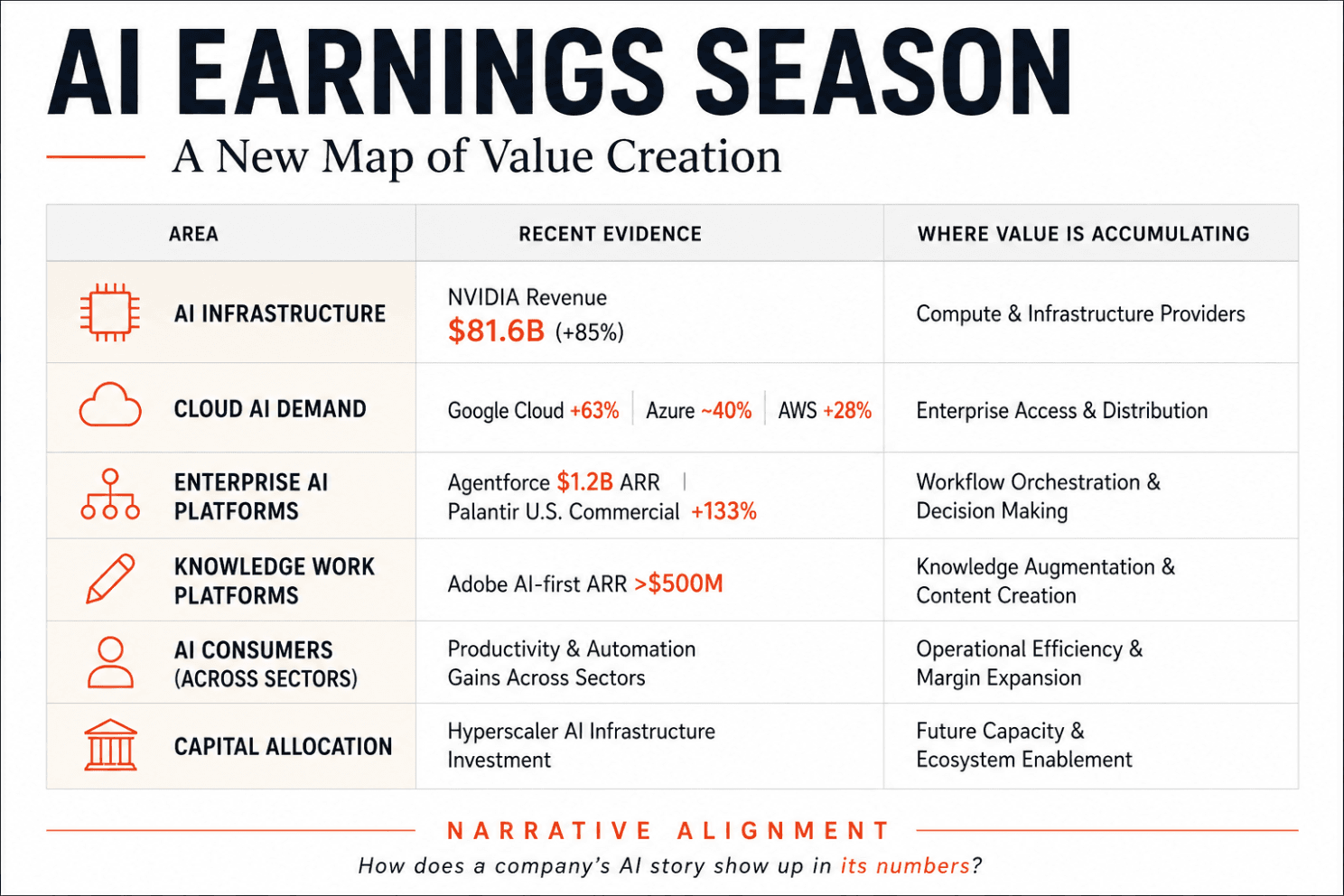
The most striking aspect of this table is the sequence. The value created by AI appears to be moving through the economy in layers.
The Builders: Where Value Appears First: Every technological shift begins by rewarding those who make the underlying infrastructure possible. Railways rewarded steel producers before they transformed commerce. The internet rewarded network equipment providers before it transformed retail. Cloud computing created enormous value for infrastructure providers before it reshaped enterprise software.
AI appears to be following a similar pattern. When Jensen Huang speaks about an AI infrastructure buildout occurring at historic scale, the financial statements increasingly validate that claim with the narrative and the outcomes are reinforcing one another in the short term.
The Platforms: Where AI Becomes Accessible: The second layer of value creation is visible in the cloud. If infrastructure providers are creating capability, cloud providers are distributing that capability to enterprises. While growth rates differ, the underlying pattern is consistent: enterprises are increasing spending on AI-enabled cloud infrastructure because they increasingly view it as foundational to future operations.
The story being told about enterprise AI adoption is now visible in contracted spending, backlog expansion and cloud growth.
The Platforms That Organise Work: The next layer is perhaps the most consequential because this is where AI begins to move from capability to organisational change. Historically, electricity created value because factories redesigned production around it. Cloud created value because companies redesigned software delivery around it. AI is likely to create value because organisations redesign workflows around intelligence that can be generated, distributed and applied at scale.
The earnings suggest that this transition has begun and will be watched closely over the next few quarters as more opportunities and risks are revealed.
The Most Interesting Layer: The Consumers Of AI: This is the layer that receives the least attention today and may ultimately become the largest source of value creation. The market remains focused on companies building AI. Yet technology history repeatedly shows that some of the greatest beneficiaries are often the adopters. Amazon was not the primary builder of the internet. Uber was not the primary builder of mobile networks. Netflix was not the primary builder of cloud infrastructure.
Each became valuable because they reorganised their businesses around a new technological capability. The same possibility is beginning to emerge across financial services, healthcare, manufacturing, consulting, professional services and customer operations. But in this category, there is the maximum confusion as well today: companies are discussing AI extensively without separately disclosing meaningful AI economics.
Across earnings calls, companies routinely disclose:
- AI users
- AI assistants launched
- AI agents deployed
- Tokens processed
- Productivity gains
- Customer pilots
What they disclose far less frequently is:
- AI-attributable revenue
- AI-attributable margin expansion
- AI-attributable cash flow
- AI-driven retention improvements
- AI-driven pricing power
Almost every technology company now has an AI story. Relatively few have AI outcomes that are material enough to reshape their financials.
Why Narrative Alignment Matters: When revenue growth, margins, customer adoption, backlog, and management commentary all move together, investors can have confidence that AI is creating durable value. Because in the end, narrative alignment is what matters. When the narrative expands much faster than the economics, investors ask harder questions.
The reason this matters is that every technological shift creates a period when it becomes difficult to distinguish excitement from transformation. Narrative alignment provides a way to navigate that ambiguity. It helps identify where the story being told by management teams is increasingly reflected in customer behaviour, capital allocation, revenue growth and business performance.