
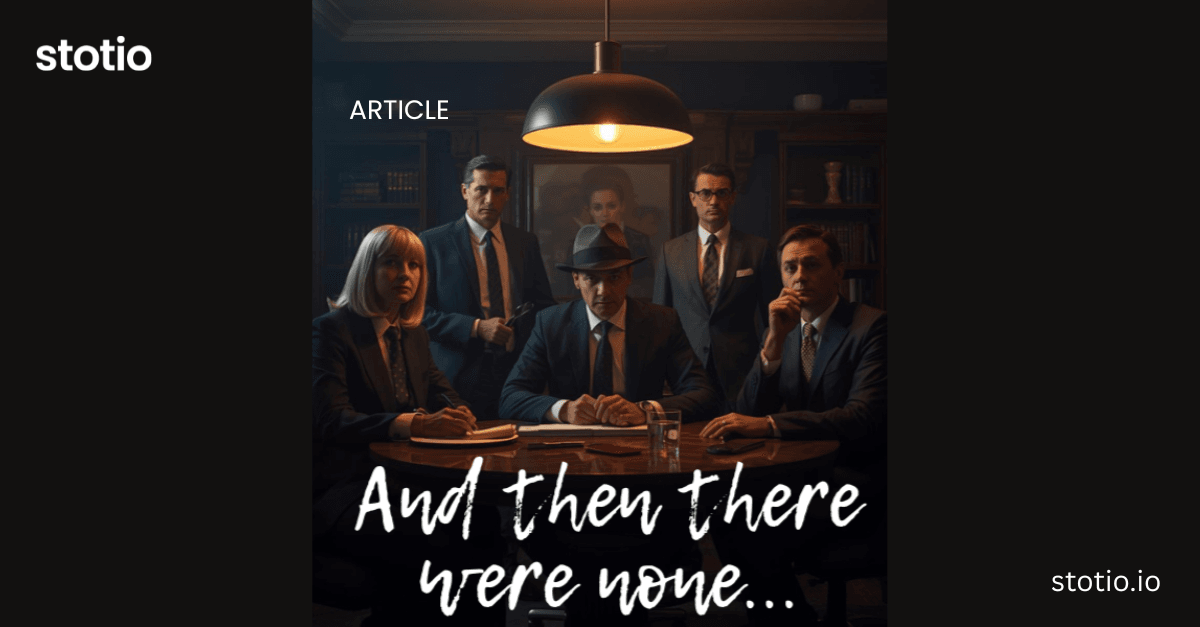
The boardroom smelled of fresh coffee and old decisions. Before the business review could start, before the KPIs could get measured, there was a tiny question hanging in the air that no one had yet dared to ask.
"Why were there forty-one metrics to be tracked? How many of these tell us whether our strategy is working?"
A long look at the screen.
“Aren’t there too many conflicting strategies for 1 growth stage company?”
Time to put the strategy cards on the table.
All for one, one for all strategy stood up and made its case smoothly. Large numbers. Global ambition. A slide that made the room feel small by comparison.
Then came the question.
"Who, specifically, will choose us over everyone else?"
The room waited. The strategy had no answer. It had been living on the size of the prize, not the sharpness of the claim. It left quietly. One little strategy, gone before the coffee got cold.
And then there were nine.
The second died on a single word.
Price. Affordable. Lowest margins. Affordable is a shelf life. The moment a cheaper option exists, and it always does eventually, the wedge becomes the wound.
And then there were eight.
The third was clever. It argued for more features in the product. Busy. Productive. Frequent releases. A changelog that scrolled for days.
"What does the customer lose if we disappear tomorrow?"
Silence. Long enough to be an answer. Busy is not the same as necessary.
And then there were seven.
The fourth had studied the competition carefully. Every move mapped. Every gap identified.
"If X does this, we must too." They concluded their presentation.
"So we are, by design, always behind? Not what's true to us?" came one fateful question.
That question was the only way out.
And then there were six.
The fifth arrived with a map of new territories. Adjacent markets. The logic of expansion.
"Have we become irreplaceable in the territory we already hold?"
"Not yet."
"Then we have no business expanding."
And then there were five.
The sixth had timing on its side. Or thought it did.
"We go upmarket. Enterprise. This quarter. Within 90 days."
"But doesn't that need a 140-day sales cycle?"
"The direction is right. The moment is wrong."
A strategy in the wrong moment is still the wrong strategy.
And then there were four.
The seventh came in with a signed document.
A partnership. A name-brand ally.
"Does the partner really add strategic value or just add a logo on a slide?"
The document didn't say. Silence was the answer.
And then there were three.
The eighth was the most dangerous. It painted a beautiful story. A story the market, they said, would love. Except the story wasn't true.
The room went cold. The story left with its author.
And then there were two.
Two remained.
"A focused bet: solve one customer problem better than anyone else and through that keep building expertise and earning trust."
The room nodded. But there was another figure. The last figure finally leaned forward - The Learning System.
"Let's build a company that learns from customers faster than the market changes: where every interaction becomes signal and every signal becomes insight and every insight shapes the product."
"The company compounds understanding. Continuously."
The room went still. The choice was made. Where data, evidence and reality together shaped the underlying choice of a company. And then KPIs could be tracked around that choice.
Five metrics swiftly replaced forty-one. Each a direct line to the strategy. Not the metrics inherited from the other eight. But metrics that answered the actual question: is this strategy working, and how would we know if it wasn't?
This is the business review. The only one worth running.
Agatha Christie's "And then there were none" showed the game of elimination at its deadliest level.
In business, walking into a review without killing everything that is not the authentic strategy, means we are already on that enchanting island - where the dashboard looks fine, the metrics are green. But somewhere in those numbers, in the questions nobody thought to ask, the ending is already being written.
Make the choice. Only then track it.
If this made you question your strategy, it is a good place to start. Explore how we help teams find that clarity at stotio.io