

Education Entrepreneurs today are building a story of the “after.” After the pandemic fuelled havoc on institutional learning. After the capital bloat and long winded blow up of one of the most funded companies. After recent AI advancements are begging the question, “can learning really be personalized for the audience of one?”
In this age of the “after”, the real stories of Education are again emerging. And here’s how the narrative can be built and pitched right.
The market is still huge but where you play matters more:
The global education economy stands at $7.6 trillion. But it’s not just edtech. Inside that sprawl, EdTech accounts for barely $163 billion today projected to touch $348 billion by 2030. That’s the gap between spend and imagination. In India, the shakeout is real - $568 million was raised in 2024, with half the number of deals. 2025 so far saw $125 million raised across 42 rounds. (sources: HolonIQ, Markets and Markets, Inc42, Tracxn)
Investors are back to fundamentals. Not traction screenshots. Not vanity cohorts. They want clarity on where in the value chain you sit, and why that layer compounds.
The new education stack is seven layers deep
Every pitch that works today names its layer, names its buyer, and names the moment that unlocks impact and outcome, not just scale.
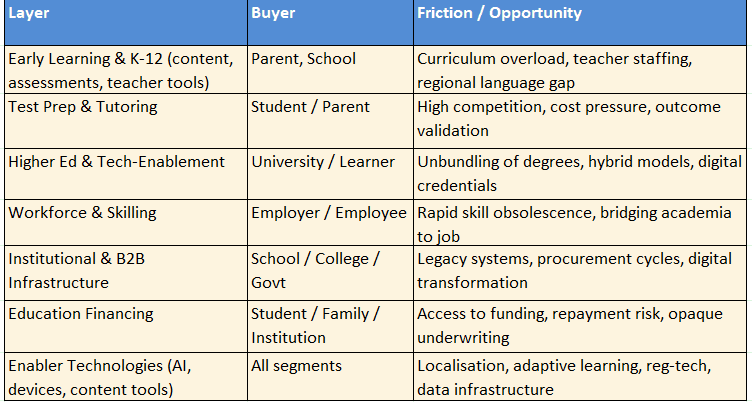
This breakdown forces clarity. A pitch that says “we cover everything” looks unfocused. One that says “we solve financing for 18-24-year-olds entering global tech workforce” lands sharper.
Sector reset: what happened & what’s happening
What used to work no longer works. Example mechanics of the reset:
- Consumer-first models (low barriers, mass user acquisition) hit a ceiling: high CAC, low retention, margin pressure.
- Investors now expect outcome validation: retention cohorts, learning gains, work outcomes. Platforms lacking this lose credibility.
- Capital is now flowing into specialisation: AI-driven adaptive learning, regional language content, financing and skilling. The broad “platform for all” experiment is being replaced. Read some of the most indepth reports by LoEstro
- Infrastructure and B2B are gaining attention: schools and colleges are digitising. But these are slower to move, meaning those who crack procurement/seasons win early.
- Financing is emerging as a critical layer: access and affordability remain constraints in many markets; ed-fintech is becoming core infrastructure rather than a nice to have.

What that means for you as an Education Entrepreneur in this age of After:
You should name the reset and acknowledge that “scale at all cost” is dead. Show how your model fits the new logic: narrower focus, measurable outcomes, repeatable economics.
- Workforce & Skilling: with job-market disruption accelerating (AI, automation, reskilling), this becomes a huge aperture. Your pitch: “This is not schooling, this is job-readiness.”
- Education Financing: Many learners don’t get access: rising awareness + digital underwriting = new models.
- B2B/Institutional Infrastructure: Selling to schools/colleges is harder but once locked in, defense is stronger.
- Adaptive/AI Learning in Tier-2/3/vernacular markets: Reach plus depth plus local language signify high leverage zone.
- Outcome-oriented models: The future is less “user count” more “outcome per user” (earnings increase, placement gain, skill certification). Investors measure that now.
How you build your pitch to land in this stack:
Start with your node: “We operate at layer X of the stack (name it).”
- Buyer clarity: “We sell to Y (buyer), who today deals with Z problem and pays ₤ A.”
- Metric of success: “We’ve achieved B retention, C cost per acquisition, D payback.”
- Why now: Link to one of the forces above (automation, funding, policy shift, device penetration).
- Moat articulation: Data asset? Institutional relationship? Geolocation/regional language advantage?
- Ask matched to stage: “We’re raising $X to achieve outcome Y in 18 months. Because at our layer, these economics matter.”
- Narrative fit: Tell the human story: why this stack, why this moment, and why you.
So the pitch needs to move from noise to narrative. At stotio, we see this pattern across every founder journey. When story turns into structure, belief follows. And in education, belief is currency.