
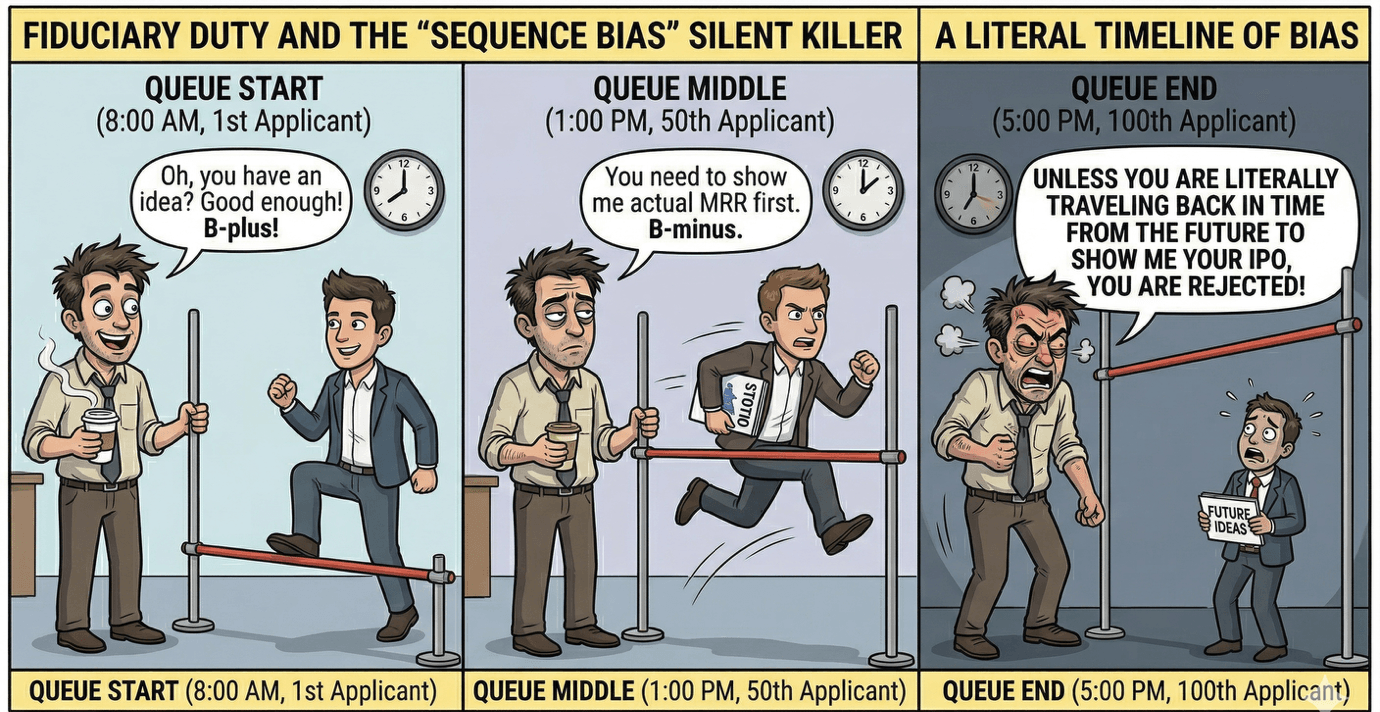
In psychology, there is a concept called Sequence Bias. It suggests that our judgment of an item is heavily influenced by what we saw immediately before it. Within the context of venture capital (VC) application cycles, sequence bias operates as a silent disruptor, impacting both objectivity and fairness. For instance, after reviewing a series of applications, the mental state of the reviewer can shift, causing them to unconsciously compare each new deck to the previous ones rather than assessing it on its own merits. This phenomenon is especially pronounced when reviewing large volumes of applications, where fatigue and repetition further amplify the bias.
If an analyst sees three "terrible" decks in a row, the fourth deck - which might only be "average"- can suddenly appear to be exceptional simply because it is better than its immediate predecessors. Conversely, after reviewing many decks in succession, the 100th founder may be subjected to a harsher, more fatigued evaluation than the first founder, whose application was judged with fresh eyes and enthusiasm. This inconsistency means that founders are not always evaluated on an equal footing, and potentially great opportunities may slip through the cracks because of the reviewer’s changing mental state throughout the process.
The Consistency Crisis
For VCs and incubators, consistency is more than a desirable quality - it's a fiduciary duty owed to Limited Partners (LPs). The expectation is not simply to find the best deals available, but to ensure that every applicant receives a fair and impartial evaluation, regardless of when their deck arrives or the reviewer’s mood at the time. If judgment fluctuates based on timing, fatigue, or prior submissions, it undermines the integrity of the selection process and may result in missed opportunities or suboptimal investments. Consistency is therefore essential to uphold trust and deliver genuine value to stakeholders.
Why Narrative AI is the Great Leveler
CohortIQ addresses these challenges by offering a "Zero-Bias Baseline." Unlike human reviewers, AI does not suffer from fatigue, boredom, or emotional fluctuations. It applies a rigorous, logic-driven scoring rubric to every application, ensuring that each founder is assessed objectively and consistently. By automating the narrative assessment, CohortIQ eliminates the impact of sequence bias and other subconscious influences, resulting in a more reliable and equitable selection process. This technology ensures that every application receives the same scrutiny, regardless of its position in the review cycle, and helps VC teams maintain the highest standards of fairness and accuracy.
Standardized Assessment: Every founder is evaluated using the same criteria, removing variability caused by human factors and guaranteeing a level playing field for all applicants.
Bias Mitigation: CohortIQ’s automated system minimises subconscious "pattern matching" - where reviewers may favour certain backgrounds or business models - allowing decisions to be driven by objective business logic rather than personal impressions.
Neutral Ground: By providing a consistent starting point for every evaluation, Narrative AI ensures that discussions among team members are anchored in objective data, rather than influenced by subjective experiences or previous submissions.
In summary, sequence bias is a hidden challenge in manual VC application reviews, but technology like CohortIQ offers a robust solution by establishing consistent, impartial, and thorough assessments for every founder. This not only enhances fairness but also strengthens the overall quality of investment decisions. Know more about stotio Cohort IQ.