
What Happens When a QBR Goes to Therapy (A light diagnostic for a very serious business ritual)
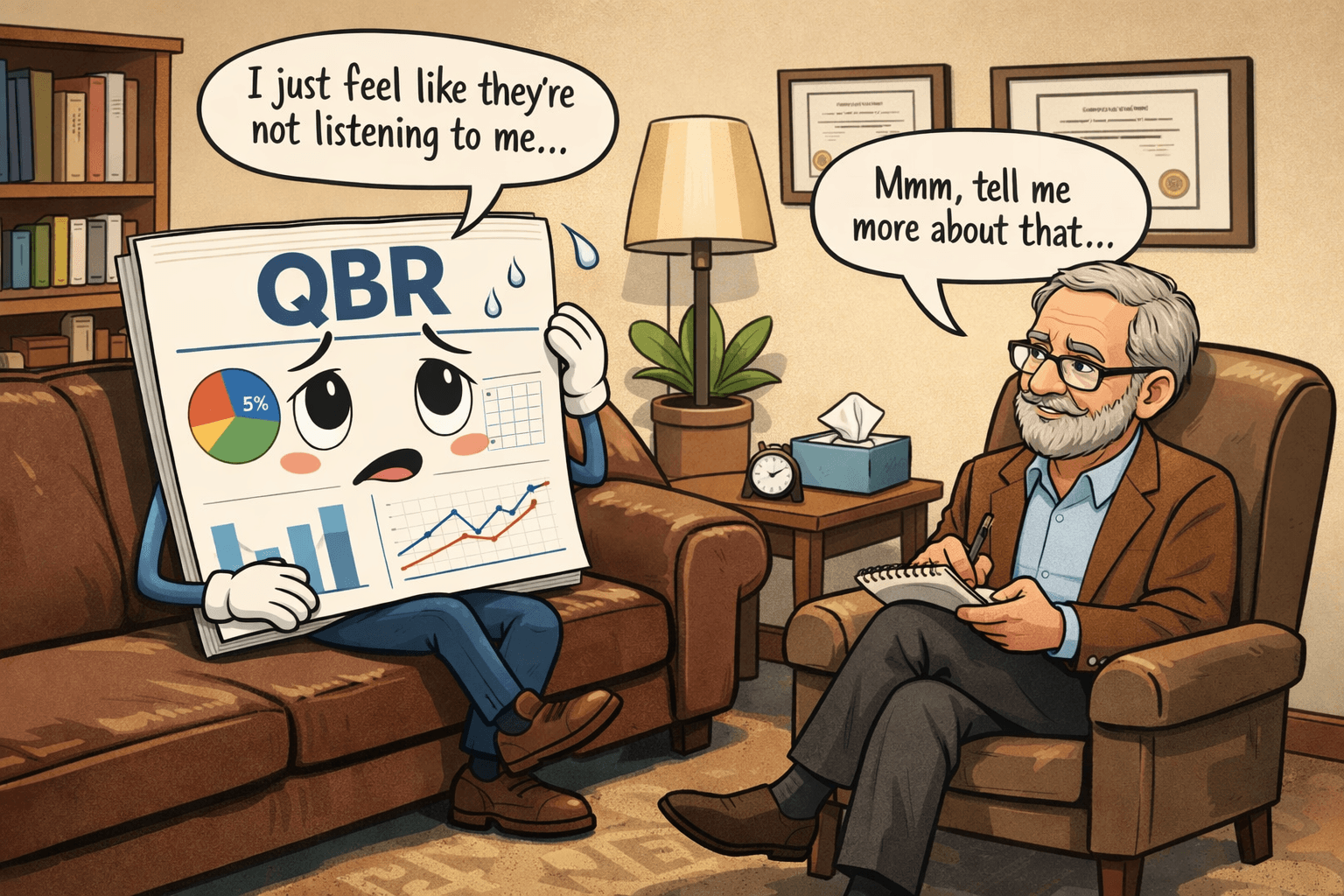
It’s 2026, and the QBR is tired. It was built to create alignment, strengthen partnerships, and spark the next wave of growth, but lately, it can’t seem to get any of those right. Meetings feel tense and even the clients are disengaged. Instead of fixing the problem, the QBR has done what many struggling systems do under pressure…it has developed coping mechanisms and unfortunately, they involve more charts. Thankfully, it is self-aware enough to realise that these mechanisms are now harming it.
After years of pretending everything was ‘on track,’ the QBR finally seeks professional help. Inside a stotio-certified therapist’s office, the issues begin to surface:
Session 1
Therapist: Welcome, QBR. Make yourself comfortable… the couch is right there. So, tell me, what brings you in today?
QBR: I just…I don’t even know how to articulate myself. I don’t know what I’m doing wrong. I show up every quarter, teams prepare for weeks and slides get polished, data gets triple-checked but then the meeting ends and… nothing really changes. So, what even is the point of my existence?
Therapist: Hmm. That sounds frustrating and existential. Let’s slow down and understand. How does that make you feel?
QBR: Professionally unfulfilled. Also, a little… resentful.
Therapist: Resentful?
QBR: Ninety slides, sometimes even more. I carry so much information, but the room doesn’t even care. People nod politely and then someone says, “Thanks, this is helpful,” and then the next quarter looks exactly the same.
Therapist: You’re clearly putting in a lot of effort, but not seeing any outcomes.
QBR: Exactly! I’m busy, detailed and thorough. But I’m not sure I’m… useful.
Therapist: When did you first notice this feeling?
QBR: When leaders started asking questions that weren’t on my slides. Things like, “What does this mean for next quarter?” or “Where should we invest more?” I usually respond with… another chart.
Therapist: And how does that go?
QBR: They don’t really say much. Which I used to think meant agreement but now I’m worried that it means disengagement.
Therapist: That’s an important observation.
QBR: I keep thinking if I just explain more clearly… add more context… another data filled appendix… it’ll click but it never really does. I feel like I’m reporting on the activity when they’re looking for a direction maybe? Does that make sense?
Therapist: Absolutely, yes it does. So, there’s a gap between what you’re delivering and what they need.
QBR: Yes! Thank you. I bring the past but they want the future, they want something actionable.
Therapist: That’s a powerful way to put it and I think you have already unpacked what the issue at hand is. In the next session, let’s dig a little deeper. I also have a task for you. Before the next session, I want you to come back with a new structure for yourself to solve the issues that you just mentioned. See you next time.
Session 2
Therapist: Nice to see you again QBR. Take the couch as usual. We made quite a bit of progress in the last session. You told me that the issue was that you were stuck in the past, with never ending slides and data that was not really saying anything. And I also gave you a task, how’s the progress on that?
QBR: Yes, yes. I took the task very seriously and it lead to a lot of introspection. One thing is clear that I can’t be a museum of the past at any cost. It’s time to leave that historical baggage behind.
Therapist: Fantastic, you are on the right track.
QBR: And there’s more. I have written down some pointers on how I can do that in a way that my slides are few, strategic and intentional. Wait, let me open my notes.
Therapist: Love it, tell me more, let’s go deeper in that direction.
QBR *visibly excited*: Okay let’s begin. I can start with an Executive Summary and open with one clear sentence, how we performed, the one insight that matters most, and exactly what I need leadership to decide. The flow should be “here’s where we are, here’s what it means, here’s what we need from you.”
Then comes my scorecard which includes 5-7 essential metrics that are easy to decode. Red for what’s not working and green for what’s working. But I will make sure to back these metrics by clear insights and explain exactly why something worked or not and what that means for the next quarter. For example, what does x mean for growth, risk, retention, or investment?
Therapist: How will you handle difficult topics? All those red points, everything that did not work, missed targets, for example.
QBR: Earlier, whenever difficult topics came up, I used to hide behind words like collateral damage and sweep things under the rug basically.
Therapist: Did it work?
QBR: I don’t think so. There was no discussion on any improvement, no one paid attention.
Therapist: What can help in changing that? Do you want them to pay more attention?
QBR *after a pause*: You know what? You are right. I do want them to notice instead of avoiding the topic altogether. I need to stop hiding from difficult conversations. Now I will say what actually got missed, why it happened, and what we’re doing differently or what we should do differently.
Therapist: Honestly will take you a long way. Also, you are right, it can help you decide what you can do next.
QBR: Exactly, this can be a useful way to decide next quarter priorities. Each tied to an insight and a metric that will prove it worked. I used to avoid this part because it felt negative. Instead, now I can name what could derail us and where we need cross-functional help. I think it will take some time for me to really adjust to this change.
Therapist: Of course it will take time. These are big steps, keep a steady pace and you shall win the race. Now keep introspecting till we meet next time.
To be continued in Part 2…