
What Happens When a QBR Goes to Therapy (A light diagnostic for a very serious business ritual) Part 2
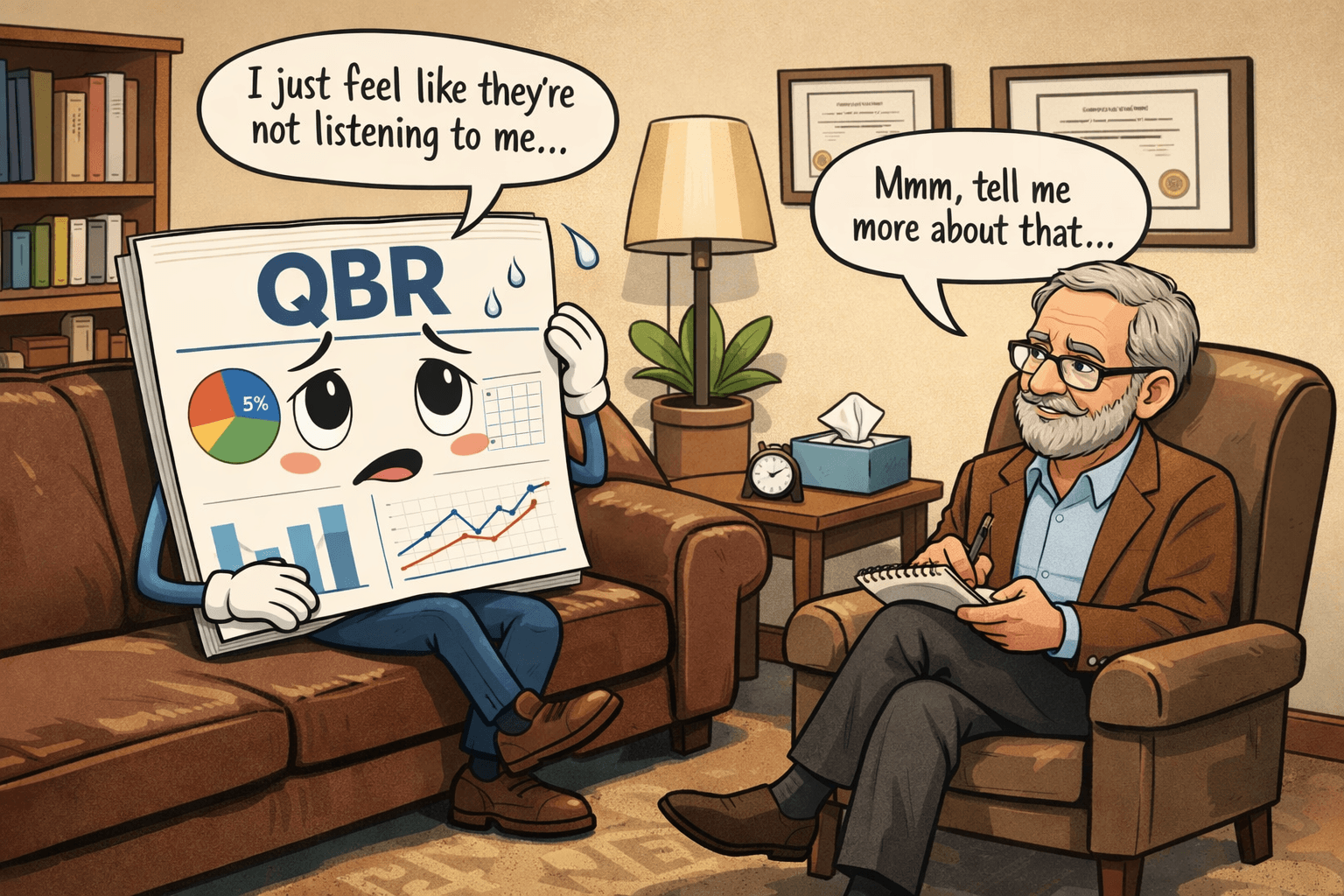
In the last session, the QBR recognised its biggest coping mechanism: hiding behind charts and polished updates instead of addressing real misalignment. What was meant to guide decisions had quietly become a reporting ritual.
Now that the first layer is out in the open, the therapist decides it is time to go deeper.
Session 3
Therapist: Well, well, QBR again. You look visibly well. Take the couch!
QBR: I won’t lie, things have been looking up. I really think next quarter could be different. But there are still a couple of things nagging me.
Therapist: These are big changes. It’s okay to feel that way. Tell me more.
QBR: What am I doing all of this for? Okay so put up the right slides, with the right insights, both positive and negative. Then that will help me plan for the next quarter. But then what? What are we trying to achieve every quarter?
Therapist: Tell me… before you walk into the room each quarter, what are you hoping will happen?
QBR: I hope they’ll see how much work was done. That they’ll appreciate the effort. That they’ll… feel informed.
Therapist: That’s a lot of hoping. Do you walk in knowing what decision you need from them?
QBR: …Decision?
Therapist: Yes. When the meeting ends, what should be different?
QBR: I usually measure success by whether I got through all my slides without being interrupted.
Therapist: That explains a lot.
QBR: So, I should… start with the outcome?
Therapist: Exactly. A strong review is designed backwards from the shift you want to create.
What do you need them to think, decide, or prioritise differently?
QBR: Oh. So instead of “Here’s everything we did,” it’s “Here’s what we need to do next and why.” But what if there isn’t an obvious decision? Does that mean that it may not need to be in a QBR?
Therapist: Yes, after all, leadership time is for resolving uncertainty.
QBR: That’s… confronting.
Therapist: Okay, let’s think of it from this angle. Where do your leaders seem unsure lately?
QBR: They keep debating where to invest more. Which customer segment to double down on. Whether our current targets are realistic. Perhaps that’s my entry point! A good outcome lives where there’s tension. I can help resolve it!
Therapist: Now you’re getting it. We are at the end of the session now and good progress. But think about what we discussed today and see you in the next session.
Session 4
QBR: I am back doc.
Therapist: I can see that. Come on now, take the couch and let’s talk. It has been a couple of weeks already.
QBR: Okay let me get straight to the point. In all these sessions we spoke about how a QBR must be forward looking, each metric must have an insight, it should tell a strategic narrative that aligns the organisation without skipping difficult topics. All of this with a clear outcome. That seems like a complicated and herculean task!
Therapist: I won’t deny that, herculean is the word.
QBR: How will I do it?
Therapist: How do you become competent at any task?
QBR *unsure*: Well through preparation?
Therapist: Yes, that’s the right direction. You must prepare for it, but the question is how? When does your preparation usually start?
QBR: About ten days before. That’s when the slide panic begins.
Therapist: And when do you talk to stakeholders about what leadership actually cares about right now?
QBR: …During the meeting, usually. But I have to definitely change that, in the last therapy session with you, we discussed how I must align on the outcome before the QBR even begins so that’s one part of the preparation.
Therapist: I am impressed. What might happen if you started those conversations weeks earlier?
QBR: Then the story I build would reflect current executive priorities with slides for the narratives, live dashboards for the deep dives.
Therapist: That sounds balanced. How do you know you’re fully prepared?
QBR: When all the slides are done?
Therapist: Is that the same as being decision-ready?
QBR: Probably not.
Therapist: What would decision-ready sound like?
QBR (slowly): We are asking for this decision… now… because of these insights… and if we don’t act, this is the risk. If the team can’t say that clearly, we’re not ready.
Therapist: That’s a powerful standard. How can you enable that?
QBR: Internal dry runs, align on the storyline. Decide who owns which section and how we transition. So we sound like one team!
Therapist: What about tough executive questions?
QBR: No more sweeping them under the rugs. I will anticipate them and think through scenarios in advance. If the story falls apart under one hard question, it wasn’t strong enough yet.
Therapist: Final question. Why do your meetings often run out of time?
QBR: Because I try to show everything, every metric, every initiative and every detail.
Therapist: So what might be healthier?
QBR (exhales): Better prioritisation and deciding what not to show. Making space for leaders to engage instead of overwhelming them into silence. Again, more preparation.
Therapist: You’ve connected a lot in these sessions!
QBR: I feel like a different person.
Therapist: That’s growth for sure!
QBR *smiling*: Can’t wait for the next QBR. The preparation begins now!
Therapist: We’re at time. I’d say you’re ready to leave the couch and re-enter the boardroom with fewer slides and stronger intentions. Until next time.
And just like that, the QBR walks out of the therapist’s office.
A transformed QBR who knows its job is to guide a decision, surface a risk, or unlock an opportunity. And that’s a session worth repeating every quarter.
The Takeaway
For leadership, QBR is one of the few moments where strategy, risk, and investment decisions converge in one room. When it works, it builds trust, sharpens priorities, and accelerates growth. When it doesn’t, it reinforces misalignment and narrative breakpoints.
That’s why at stotio, we help redesign the QBR as a decision-driven system, aligning narrative to outcomes, surfacing the right tensions, and connecting metrics to strategy. It’s not just advisory, our platform supports teams in bringing greater clarity, alignment, and structure to their reviews, enabling the shift from simply reporting activity to meaningful progress, quarter after quarter.
Connect with us to know more, because sometimes what your QBR really needs…
is a good therapist.