

A HBR 2023 article shared this powerful narrative.
“Last year, poachers killed 35,000 elephants for their tusks. We’re facing an all-out crisis. But we have a simple threefold strategy to save elephants: Stop the killing. Stop the trafficking. Stop the demand.”
The headline of the article?
Your strategy needs a story.
How does this apply for business and what are the common misconceptions that need to be addressed? Read on.
When story meets strategy
Misconception 1: Most people, when they think of storytelling, for the business world, equate it with marketing. With campaigns. With social media copy. With reels and videos.
But storytelling, in its true essence, is far more ingrained in the business and it starts right from defining and sharing the strategy of the company.
Famed venture capitalist, investor, Ben Horowitz who had invested in Facebook and in Twitter had made his point very clear when he said, “Your story is your strategy.”
His viewpoint was that the questions any business needs to answer are rooted around many “whys” to sharply define the strategy of a company
- Why they are solving a particular problem
- Why should clients buy from them
- Why should people join them
And he believed that that the answer to the whys lies in the company’s story and that a good leader can articulate that brilliantly. Story meets strategy.
Isn’t storytelling all art?
Misconception 2: Many people assume that storytelling is all about art which creators build magically, or in current times, magically outsource to the LLM of the day.
But let us examine this argument in the context of one the most supposedly quantitative disciplines of valuation which is supposed to be all about numbers and which is essential in the strategy lifecycle of a company be in during fund raising or mergers or IPO.
Well known valuation professor, Aswath Damodaran, in his book, Narratives and Numbers, spoke about how the valuation of the company is deeply influenced by the narrative one assumes and builds about a company.
The narrative and the numbers go hand in hand he shared and if the narrative changes, that influences the market size, the competitive set and strength and in turn, the valuation.
He shared a 5-step process to marry both the left brain and right brain approaches when it comes to the field of valuation, a key step in communicating the strategy of the company to investors.
Marrying narrative and numbers in valuation
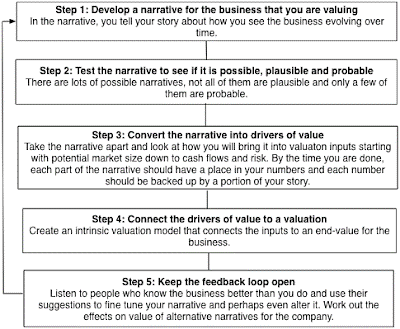
Source: Narrative and Numbers, Aswath Damodaran
Story meets strategy!
But, wait, who does it really apply to?
Misconception 3: This can at best only to startups as they are trying to build their initial narrative. As companies grow, they have this all figured out.
The reality is that the strategy of a company keeps evolving over its growth stages. And that results in multiple interconnecting levels of the story of the company.
For example, an early-stage company needs to build a narrative around its business and its potential so that potential investors can see the story in the strategy clearly. Strategy is story.
As a company grows, a mid-size company with decent revenue and product market fit might still need to reposition themselves in a competitive market or where a new technology threatens to change the dynamics of the industry. Strategy is still story.
As the company grows to become a large behemoth, with multiple divisions, teams, across locations, at times, disconnects happen among the various levels of the company. People need to align on culture, on goals, with stories simply told that connect the overall strategy to their context. Strategy is story, even then.
The bottom line: “The essence of strategy is choosing what not to do." — said Michael E. Porter.
By ensuring that choice is communicated with simplicity and with a clear narrative, story lies between the Once upon a time and the Happily ever after of Strategy.