
Your Investment Pitch Will Enter Rooms You’ll Never See. It Must Learn to Travel Alone.

“…a text's unity lies not in its origin but in its destination. Yet this destination cannot any longer be personal: the reader is without history, biography, psychology; he is simply that someone who holds together in a single field all the traces by which the written text is constituted…”
- Roland Barthes, The Death of the Author
Barthes was writing about literature in 1947. But every founder who has ever sent a deck into the world and waited for a reply knows exactly what he meant. The moment you hit send, the author dies. What lives on is the story and whether it can stand without you.
Most founders discover this too late. A Reddit thread captures this misunderstanding well (see screenshot below). A founder was surprised to find out that more often than not, pitch decks are read alone, forwarded as PDFs or discussed in rooms that a founder can only dream of entering. After all, this isn't Shark Tank. Even on Shark Tank, founders pass through a multi-stage process before anyone sees them pitch in person.
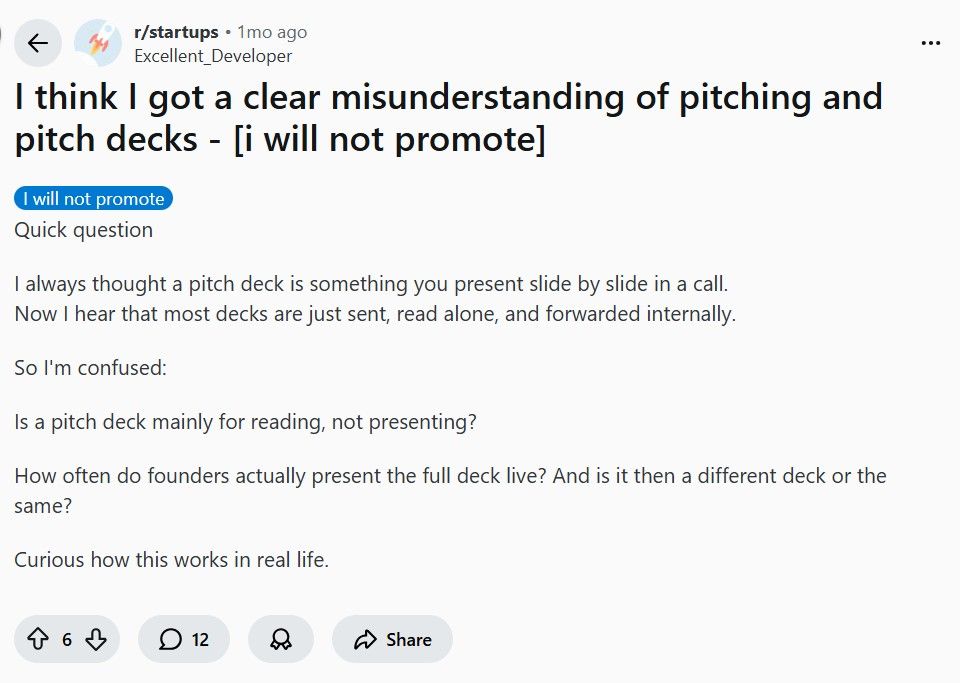
Source: Reddit
Your pitch must learn to travel alone and prepare itself to be downloaded, screenshotted, debated in a partner meeting and to be compared against five others in a Sunday review stack. You are not going to be present in all those situations highlighting, emphasising or explaining. And if the pitch can’t defend, explain, and position your company on its own then you’ve already lost leverage.
These journeys of pitch decks to lands unknown are more treacherous than most founders realise.
The average VC spends less than 3 minutes and 44 seconds reviewing a deck. That's less time than it takes to make a cup of instant coffee. Moreover, VC analysts reviewing thousands of decks annually invest in a tiny fraction of them. The issue is that founders don’t know how to craft their story first and grab attention within the first minute itself.
The structural problem
Most founders approach pitching as an elaborate performance. They rehearse their delivery, polish their slides, obsess over font choices. What they don't do is architect their deck for the journey it will actually take alone in choppy waters.
The deck that lives on a laptop has a different job than the deck you present live. It must carry context without you and answer the questions you'd usually answer with a hand gesture or a follow-up sentence. It must feel like a conversation even when it's a monologue.
Investors evaluate startups through pattern recognition matching what they see in your deck against mental templates of past winners and losers. Your narrative either fits a pattern they trust or it doesn't. If it doesn't, no amount of beautiful design saves it and the window to establish that pattern is narrower than you think.
For example, that first reviewer is not really trying to find good fits, they might only be sifting the hay from the chaff. In short, your deck must survive someone whose job is to say no.
What investor-readiness actually means
Real investor-readiness is narrative coherence. It's a story that holds together whether an analyst is reading it at 9 AM or a partner is skimming it on a Sunday. It's all about knowing that your problem slide, your market slide, and your traction slide are all telling the same story in the same direction (even when you are not in the room to tie the threads together).
Behavioral science tells us that investors form impressions within seconds, then spend the rest of the time justifying that first impression. Which means your job is to trigger the right instinct first, then give them the data to back it up.
That's a strategy problem that you must address in your deck.
Once the pitch is perfected and strategy flawless, it can get you in the right room. The post room entering theatrics is a different ballgame and requires preparation. Even founders who get the narrative right often walk into investor conversations underprepared for what follows. Investor conversations are pressure tests. The questions are designed to probe for founder conviction, market understanding, and how well you know what you don't know. The best founders use the questions to deepen the narrative and often to reiterate till perfection.
Building a pitch that travels
This is where tools like stotio's PitchReady change the calculus. Rather than starting with slides, PitchReady starts with narrative strategy, structuring your vision, your market context, and your data into a coherent story built around how investors actually think and decide. The pitch that comes out the other side is one that can hold its own in a room you never enter.
The preparation layer matters just as much. An AI-powered investor Q&A simulator that pressure-tests your responses, surfaces your weak spots, and helps you build the muscle memory to handle tough questions before the conversation that counts.
By the time you send the deck at 11 PM, the author is already dead. The only question is whether the story survives.
Your pitch has rooms to enter. Make sure it's ready.
Start with PitchReady.